L
actate thresholds are key reference points in endurance training, as they reflect how the body responds as exercise intensity increases.
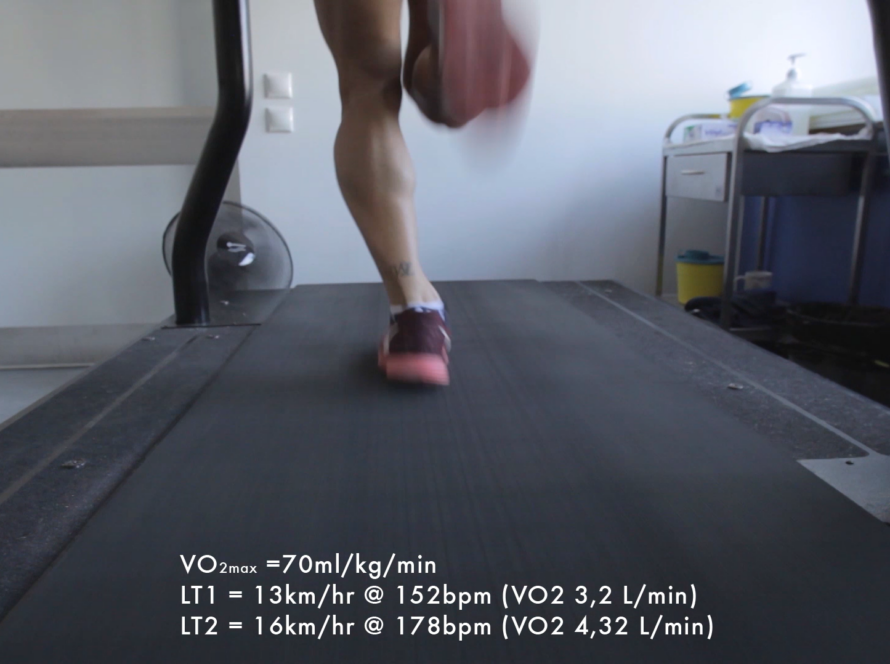
The LT1 (1st lactate threshold) represents the first meaningful rise in blood lactate concentration. From a training perspective, it corresponds to a low to moderate intensity, where the body operates primarily aerobically and the effort remains controlled. It is the point at which comfortable aerobic exercise begins to feel more demanding, without yet losing its predominantly aerobic character.
The LT2 (2nd lactate threshold) occurs at a significantly higher intensity and represents a critical boundary. At this point, lactate production clearly exceeds the body’s ability to remove it, and its accumulation begins to rise in a pronounced and aggressive manner. For the endurance athlete, LT2 is particularly important, as it indicates how high an intensity can be sustained for a meaningful, but limited, duration before fatigue increases rapidly.
The VO₂max (maximal oxygen uptake) defines the upper limit of aerobic capacity. Lactate thresholds, and especially LT2, determine how effectively an athlete can utilize this capacity in practice. This is why two athletes with similar VO₂max values may demonstrate different performance levels, if one is able to sustain a higher percentage of their aerobic capacity without rapid accumulation of fatigue.
Training at intensities that “flirt” with threshold values leads to important physiological adaptations, such as:
- improved ability to clear and reutilize produced lactate
- increased mitochondrial function
- improved oxygen transport and utilization
- delayed onset of fatigue
These adaptations allow the runner to sustain higher intensities for longer periods, with better control of physiological stress.
According to the literature, the lactate curve* is one of the strongest predictors of performance in endurance sports.
Anaerobic Threshold: Its Concept and Role in Endurance Sport
* The lactate curve describes the change in blood lactate concentration as exercise intensity progressively increases.
The Findings
Understanding lactate thresholds has little value if it cannot be translated into proper training decisions.
In practice, the goal is not for the athlete to “hit” a specific pace, but to operate at the correct intensity — within the range where the body can perform efficiently without becoming physiologically deregulated.
Training close to LT2 is the primary tool for improving performance, as it represents the highest level of stress that can be sustained under control.
Practical Approach
LT2 training is characterized by:
- stable intensity
- controlled effort
- duration that allows the maintenance of the desired intensity without metabolic and mechanical disruption
Indicative Training Methods for Performance Development
Continuous steady-state training (tempo run)
- 20’ – 40’ at an intensity close to LT2, depending on the training phase and the athlete’s level
- intensity remains stable and controlled throughout
- the effort feels demanding, but without excessive metabolic strain or disruption
Goal:
the development of the ability to sustain high intensity for prolonged periods
Interval training at LT2 (cruise intervals)
- 3–5 repetitions of 8–10 minutes
- with short recovery intervals that do not allow full recovery
- at an intensity close to LT2, i.e. the highest controlled intensity that can be sustained
Goal:
the accumulation of greater total time at intensities close to LT2, with stable and controlled load, without metabolic and mechanical disruption
Progressive training
- gradual increase in intensity throughout the session
- starting at lower intensity and progressively approaching LT2
- finishing close to LT2, without exceeding the desired intensity
- total duration: 30’ – 60’, depending on the training phase and the athlete’s level
- the portion near LT2 typically lasts 10’ – 20’, maintaining controlled load
Goal:
the development of the ability to control intensity and transition smoothly toward LT2 without abrupt metabolic stress
Key Principles of Application
- be performed 1–2 times per week
- be scheduled on days with adequate recovery before and after, to maintain the quality of the effort
- be maintained at a controlled intensity level
Critical Point
Threshold training should not be performed at intensities higher than intended.
Exceeding the target intensity leads to:
- metabolic disruption
- compensatory increase in heart rate
- loss of the intended training stimulus
Coaching Principle
Pace per kilometer is NOT the reference point in LT2 training. The reference point is intensity and the metabolic cost it entails.
Integration into the Overall Training Process
- bridges the gap between aerobic base and high-intensity training
- improves the ability to sustain high intensity under control
- allows a greater percentage of aerobic capacity to be utilized
and represents the primary mechanism through which physiological capacity is converted into actual performance.
Closing
Performance is not determined only by how fast a runner can move, but by how fast and for how long that intensity can be sustained.